Teaching is both challenging and deeply rewarding. In the classroom, I aim to help students develop linguistic precision, cultural awareness, and confidence in engaging with language in both historical and contemporary contexts.
Teaching in Germany
At Humboldt-Universität zu Berlin, I teach courses in German linguistics and the history of the German language. My teaching there has included UE Deutsche Grammatik, GK Einführung in die ältere deutsche Sprache: Mittelhochdeutsch, and SE Einführung in die historische Grammatik des Deutschen.
These courses allow students to strengthen their understanding of German grammar, develop familiarity with earlier stages of the language, and engage with questions of historical language change. My teaching in Germany combines close work on linguistic structure with broader historical and philological perspectives.
Teaching in the United States
In the United States, I taught German and Dutch language courses as well as courses connected to German-language culture and literature. At Indiana University, I served as an Associate Instructor for undergraduate German and Dutch courses. Later, at Denison University, I taught German and also developed my own courses, including Sports and Popular Culture in German-speaking Europe.
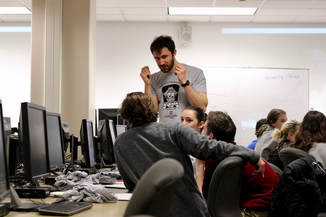
At Denison University, I also developed interdisciplinary courses in collaboration with International Studies, Data Analytics, and Digital Humanities, through which students were introduced to a range of tools and methods used in linguistic analysis. Under this rubric, I taught Languages of the World and Analyzing Linguistic Data. In the latter course, students worked with R, PRAAT, and other computational tools for coding, statistical analysis, and the investigation of linguistic data across several subfields of linguistics.
I have also taught in online formats and participated in language teaching connected to study abroad settings. These experiences have shaped my teaching approach by showing how strongly language learning benefits from cultural context, active participation, and exposure to authentic linguistic environments.